What's happening in your neighborhood
Car accidents, thefts, fights — short pins on the map. They live from a few hours to a day and disappear on their own, so the map never goes stale. Others can confirm or dispute a pin.

Mapiko
See on the map what happened in your neighborhood and where the nearest shelter or Invincibility Point is — and share yourself. Viewing needs no sign-up. This is a beta: some things may not work perfectly yet.
Free · View without signing up · Beta
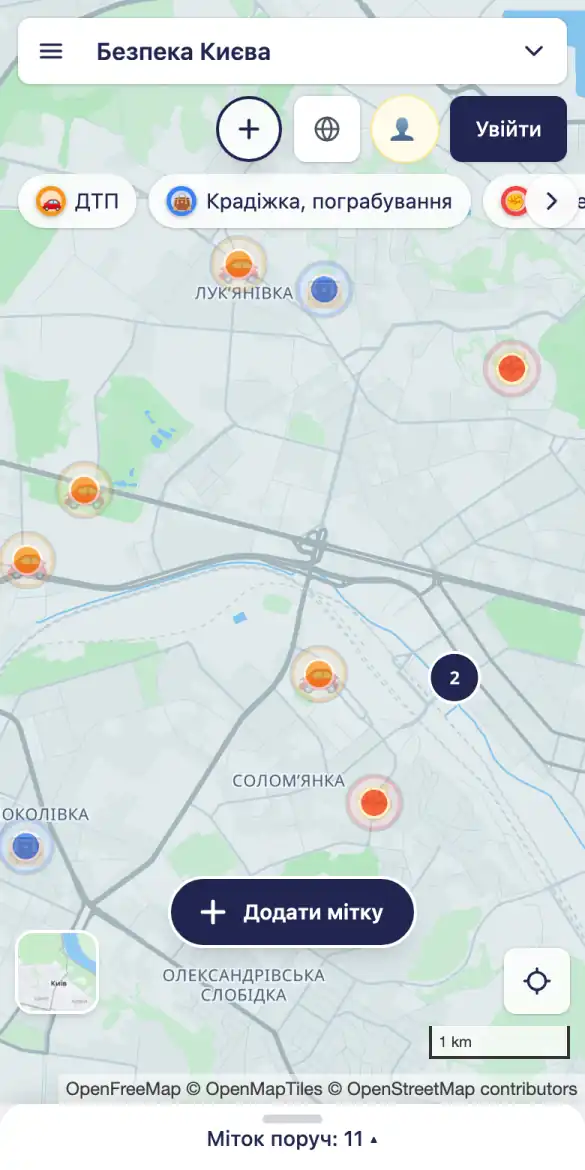
Car accidents, thefts, fights — short pins on the map. They live from a few hours to a day and disappear on their own, so the map never goes stale. Others can confirm or dispute a pin.
Maps built from open data: shelters in Kyiv and Bucha, Invincibility Points, drinking water pumps. It's a directory kept by the map owner, not an event feed. The data comes from open sources — check on site before you go.
For volunteers — the "Volunteer map" template: new places appear after the team approves them.

Cyclists, dog owners, anglers, mushroom pickers — meeting spots, useful places and tips on one map. The map author decides who can add pins.

Open a map. No sign-up needed to view.
Add a pin. Choose a type and briefly describe the place and what happened. You can add pins where the map author allows it.
Confirm or correct. Others see the pin and can confirm or dispute it, and the map team fixes small mistakes.
You can view maps without an account.
A pin's author isn't shown publicly.
Your nickname is shown under your comment (if you set one and it passed review) — everyone can see it. Without one, it says "Participant".
To fight spam, we store a hash of your browser fingerprint and a hash of your IP — not the data itself. The IP hash is deleted after 30 days.
We don't track your location: geolocation turns on only after you tap and allow it, and we don't store routes.
No ads. Visits are counted without cookies or personal data, on our own server; cookies are technical only.
Open any of them and see what it looks like.
For your yard, building, volunteer group or club. You choose the template and the rules: who adds pins and how long they live. Creating a map requires signing up (email and password).
Create your own mapNot a substitute for 102 and 112.
Right now, yes — it's a beta. What comes next isn't decided yet; we'll update this if it changes.
To view maps — no. To add pins — it depends on the map: the author decides whether everyone, only people who saved the map or only the author can do it. Only registered users can create their own map.
Pins on a public map are visible to everyone. We don't show a pin's author publicly. Only platform admins see the anti-spam data, and even then it's service data, not the hashes themselves.
Locations of military enlistment offices (TCC), the military and the police. Names, photos of people, phone numbers, license plates — a pin describes a place and an event, not a person. Serious things (violence, abduction) are published only after the map team reviews them.
In the pin card: "⋯" → "Report". Reports on pins are handled by the map team; reports about TCC/the military/the police and personal data go to the platform team.
No. The service doesn't replace emergency services. If there's a threat to life, call 102 or 112.